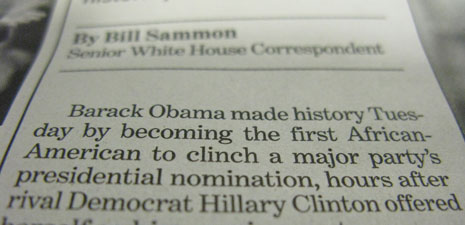
The vast majority of the news we consume cannot be described as “impartial.” During the past year, subtle or overt bias appeared in almost all of the news coverage of the upcoming election that I’ve seen. It’s disturbing, it’s unfortunate, and it’s impossible to avoid. In what’s become an exceedingly rare occurrence, I agree with the main premise of one of Joe’s recent political blog posts.
Varying degrees of left- or right-leaning bias can be found on all of the major media outlets, whether it’s print, broadcast, online, or radio. It’s difficult to determine when such comprehensive bias hijacked our news sources, but I think the cause is easier to pinpoint. Let’s blame it on the Internet.
A medium itself is impartial technology, generally invented for altruistic purposes, but as soon as a printing press or broadcast gains an audience, there will be an effort to sway the masses that consume it. Mass media bias is not new and has many possible sources and causes. However, for the past century or so, we’ve enjoyed many major media organizations that strove for—and prided themselves on—having as close to impartial coverage as possible. Claiming to be “fair and balanced” while actually being anything but does not count. It’s difficult to maintain neutrality on controversial topics and doing so requires unceasing vigilance, so it’s unsurprising that there are many notable failures in that struggle.
In an era when daily newspapers are bleeding subscribers, when TV stations are losing viewers to the Internet, and when the big money of classifieds has been lost to Craigslist, it’s no wonder that mass media is looking to compete with what’s available online. And it’s no secret that most bloggers have not attended the Columbia School of Journalism. If a blogger can say whatever they wish, they are bound to be more entertaining than an unbiased report; inflection and voice can go a long way. Here’s the problem: mass media has forgotten that they need to be informative first, entertaining second, and the public has forgotten that this order of priorities is ultimately for the best.
Blatant, widespread disregard for neutrality seems to be a recent development: something that’s surfaced in the past few years. Like Christians before the lions, liberals are often called to appear on Fox News, but their purpose is merely to serve as anvils to the hosts’ hammers. While Fox is an easy target for their blatant Republican love, the fact is that no network is untainted. It’s my choice to scoff at John McCain or Sarah Palin after their latest gaffes—most appropriately when assembled in a fantastic Daily Show segment; it’s frightening when respected news anchors are snickering along with me.
Rather than wax on about how Obama is the Second Coming of Christ—though he may, in fact, be the Savior of American Politics—I want the media to ask tough questions and demand answers of all politicians so I can make the most informed choice possible. That’s your job in a nutshell: report facts in a coherent and digestible manner.
Disclaimer: I am one of those ivory tower, far-left wing, liberal elitists.